
What Is Data Sovereignty? Why It Matters for Tribal Nations
By Tiffany Edmonds
In today’s digital world, data is power — and for tribal nations, that means owning and protecting data is a matter of sovereignty.
Whether its court records, case notes, or financial service documentation, every field, every form, and every report tells a story. You’re not just managing records — you’re stewarding your community’s stories, needs, and decisions. And the systems you use to manage it should not only help you work efficiently—they should also respect your right to full data sovereignty.
We believe that tribal data sovereignty is not optional, or a “feature”—it’s fundamental. It’s central to how we design, implement, and support the RiteTrack platform. Because when tribal nations are equipped with software that strengthens their sovereignty instead of undermining it, they’re empowered to lead their own path forward—on their own terms.
What Is Tribal Data Sovereignty?
Data sovereignty refers to the right of a nation or governing body to control the data it generates — including how it’s collected, accessed, stored, and used. For tribal governments, data sovereignty is an extension of tribal sovereignty itself. This concept extends from broader tribal sovereignty, the inherent authority of Indigenous nations to govern themselves. Just as tribes have the right to make laws, administer justice, and manage their land and resources, they also have the right to define what data is collected, who can access it and use it, and decide where it is stored and how it is protected.
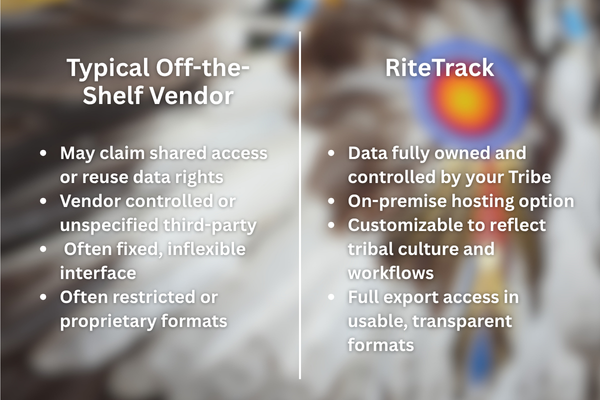
Unfortunately, many commercial software systems are built without data sovereignty as a priority. They may be owned by state-level vendors, store your data in third-party cloud systems without tribal oversight, or offer limited visibility into what’s being collected or shared. Some even retain the right to access, replicate, or analyze your program data for their own purposes—without clear consent.
That’s not just bad practice. It’s a threat to tribal data sovereignty.
Why Data Sovereignty Matters in Tribal Justice and Social Services
1. Trust and Community Protection
Tribal courts, TANF programs, and family services agencies all handle sensitive, confidential data. This data reflects the real-life circumstances of Native children, families, and community members. Misuse or exposure—whether accidental or deliberate—can erode community trust, trigger retraumatization, or violate tribal law and custom.
2. Self-Governance and Decision Making
Data is a powerful tool for governance. Tribes use it to plan services, manage caseloads, report to funders, advocate for resources, and improve outcomes. If that data isn’t complete, accessible, or accurate—or if it’s filtered through external definitions—then decision-making suffers.
3. Compliance and Cultural Alignment
Federal and state programs often come with rigid requirements that don’t align with Indigenous ways of knowing or administering justice. Having control over how data is defined and reported allows tribes to comply with mandates without compromising cultural integrity.
How RiteTrack Supports and Respects Tribal Data Sovereignty
We built RiteTrack specifically for tribal governments and justice systems. Our goal has never been to provide a one-size-fits-all solution, but to offer a customizable software that reflects how each tribe governs, serves, and protects its people.
- You Own Your Data: Data sovereignty means data ownership. Your tribe’s information is never repurposed, sold, or accessed without your permission. It belongs to your program, your people, your leadership–period.
- Flexible Hosting Options: Choose between secure provided hosting or on-premise installations depending on your infrastructure, preferences, and tribal IT policies. Your data stays within your control, with deployment designed around your sovereignty needs.
- Role-Based Permissions: RiteTrack allows detailed configurations of user roles and access, ensuring the right people see the right information—nothing more. This mirrors your tribal protocols and enhances internal accountability.
- Transparent Development and Support: We partner with your team during every phase of implementation. From initial configuration through support and updates, we listen to your needs and help evolve the system as your programs grow. We don’t dictate how you should work—we build around how you already do.
A Real-World Example
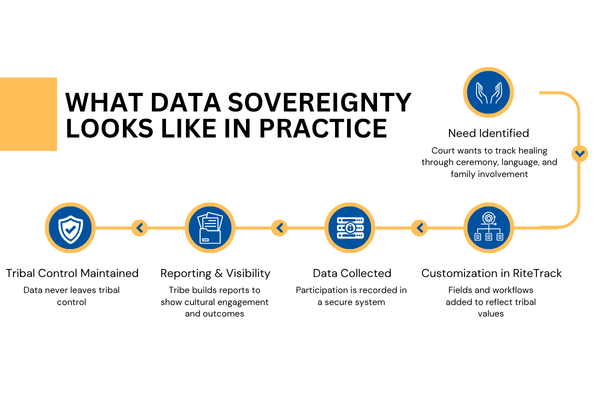
Let’s say a tribal court using RiteTrack wants to track culturally specific rehabilitation milestones—such as participation in ceremony, family reconciliation, or language programs. These are vital components of healing in the community—but they aren’t measured by most state or federal systems.
With RiteTrack, the court can define custom fields, workflows, and reporting to reflect these goals. The data stays local, reporting can highlight cultural engagement, and decisions around visibility or sharing rest with the court—not the vendor. That’s true data sovereignty in action.
Questions to Ask When Choosing a System
If you’re evaluating new software—or using a system that wasn’t designed for tribal agencies—here are some questions to ask:
- Who owns the data in this system?
- Can we export or migrate it at any time, in usable formats?
- Where is it stored, and can we verify that location or access policy?
- Does the vendor share or analyze our data without explicit consent?
- Can the system be customized to reflect tribal laws, culture, or protocols?
- Will this system evolve with us—or force us to adapt to it?
If the answers leave you uneasy, it might be time for a change. Want help evaluating your options? Check out our free guide on choosing sovereign data systems.
Software Designed for Sovereignty, Built for Better Outcomes
We believe software should empower, not constrain. It should reflect the values, governance, and priorities of each tribal nation it serves. It should enable better service delivery without sacrificing sovereignty.
We’re honored to work with over 65 tribal nations across the U.S., supporting courts, social services, reentry programs, and more. And we’re proud that those partnerships are built on three core principles: Honesty, Integrity, and Trust. (Yes, that’s our HIT acronym—and one we’re proud to stand by.)
If you’re ready to explore a case management system that puts you in control—of your data, your processes, and your future—we’d love to talk.
Schedule a Demo to see how RiteTrack supports data sovereignty and cultural alignment.
Contact Us with your questions—we’re happy to connect you with a real person who knows your challenges and can walk through solutions.
Because your data should serve your people—not the other way around.