
What Tribal Elder Programs Should Know About Title VI PPR Reporting
By Tiffany Edmonds
For many Tribal Elder Programs, reporting is one of the most important parts of program administration. It helps document the services being provided, supports accountability, and gives Tribal leadership, elders, and the broader community a clearer picture of the work being done.
But reporting can also be one of the most time-consuming parts of the job, especially when program information is spread across spreadsheets, paper files, documents, shared drives, calendars, or multiple disconnected systems. That is why Title VI PPR reporting is not just something to think about at the end of the year. It is something that is shaped by the way data is collected, organized, and maintained throughout the year.
What is Title VI PPR Reporting?
The Title VI Program Performance Report, often referred to as the Title VI PPR, is the annual report used by Title VI grantees to report program performance information. According to the Administration for Community Living, the Title VI PPR must be completed and submitted annually as required by the Older Americans Act. ACL also states that the PPR covers both Part A/B and Part C programs and is due within 90 days of the end of each budget period, though exceptions may apply. For Tribal Elder Programs, this means reporting may include information tied to nutrition services, supportive services, caregiver support, and other program activity connected to Title VI funding. The PPR is submitted through the Older Americans Act Performance System, or OAAPS, which ACL identifies as the data submission portal grantees use to report PPR data.
Why Title VI Reporting Matters
It can be easy to think of reporting as a requirement that simply has to be completed. But for Tribal Elder Programs, reporting can serve a bigger purpose. ACL notes that reporting is part of program accountability and helps keep Tribal council, elders, and the community informed about program operations. That is an important distinction. Reporting is not only about submitting numbers. It is also about showing what the program is doing, how elders are being supported, and where services are making an impact.
When reporting data is accurate and easy to access, programs are in a better position to answer questions such as:
- How many elders received services?
- What types of support were provided?
- How often were services delivered?
- How many meals were served or delivered?
- How much transportation support was provided?
- How many caregivers received support?
- What service needs are growing?
- Where might the program need additional resources?
Those answers can help support planning, funding conversations, internal reviews, and communication with leadership.
What Types of Services Are Connected to Title VI?
Title VI grants support important services for Native elders. ACL states that Title VI grants are used to fund nutrition, supportive services, and caregiver support services for elders.
ACL also identifies Parts A and B as supporting nutrition and supportive services, while Part C includes caregiver-related services such as caregiver information, assistance in accessing services, counseling, support groups, caregiver training, respite care, and limited supplemental services. Because of this, Title VI reporting is often connected to a wide range of program activity. That may include congregate meals, home-delivered meals, transportation, information and assistance, outreach, case management, visiting or telephone contacts, respite care, and other forms of elder or caregiver support. For staff, the challenge is not only providing those services. It is also making sure the right information is captured along the way.
Reporting Starts Long Before the Deadline
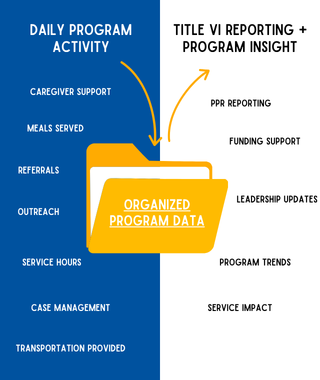
The easiest time to prepare for Title VI PPR reporting is not when the report is due. It is throughout the year, while services are being provided. Every meal served, ride provided, caregiver supported, referral made, or case note entered can become part of the larger reporting picture. If that information is tracked consistently from the beginning, reporting becomes much easier later. But if the information is scattered across different spreadsheets, handwritten notes, paper files, or shared drives, staff may have to spend significant time pulling everything together. They may need to double-check counts, clean up duplicate records, confirm dates, or search for missing details. That can make reporting feel more stressful than it needs to be. A stronger year-round tracking process can help programs reduce that last-minute scramble and give staff more confidence in the information being reported.
Common Reporting Challenges for Tribal Elder Programs
Every program is different, but many reporting challenges come back to the same issue: the data exists, but it is not always easy to find, verify, or connect.
For example, a program may track meal deliveries in one spreadsheet, transportation in another, caregiver support in another, and case notes somewhere else. Staff may know the services are being provided, but when it is time to report, they have to bring all of that information together manually.
Some common challenges include:
- Tracking duplicated and unduplicated service counts
- Keeping meal, transportation, and caregiver support data consistent
- Connecting services back to the right elder, caregiver, household, or case
- Compiling totals from multiple tracking tools
- Finding supporting documentation
- Entering narrative responses alongside service numbers
These issues can create extra work even for programs that are doing an excellent job serving elders. The problem is not the quality of the program. The problem is often the tracking process.
Good Reporting Depends on Good Data
Title VI PPR reporting depends on service data being collected in a usable way. That does not mean every program needs a complicated process. In fact, the best tracking methods are usually the ones that fit naturally into daily work. Staff should be able to document services as they happen, connect information to the right person or case, and access that information later without searching through several different places.
One of the most valuable parts of reporting data is that it can help programs tell the story of their work.
ACL’s Title VI Infographic Toolkit guidance notes that Title VI grantees already collect program information for their annual PPR, and that PPR data can be used to help tell the story of a Title VI program. That is important because program data can do more than fill out a report. It can show patterns, highlight needs, and help leadership understand the value of services being provided.
For example, reporting data may help show that transportation requests are increasing, caregiver support is becoming a larger need, or meal delivery is reaching more households than it did in prior years. It may also help programs identify gaps, plan staffing, prepare for funding discussions, or explain program impact to Tribal leadership.
When data is organized, it becomes much easier to use it for more than compliance.
Paving the Way for Easier Title VI PPR Reporting
Tribal Elder Programs can make reporting easier by thinking about data collection before the reporting deadline arrives. The more organized the data is throughout the year, the easier it becomes to complete reports, review program activity, and communicate the impact of services.
A few helpful questions to consider include:
- Are we tracking services in a consistent way throughout the year?
- Are staff using the same definitions and categories?
- Can we easily see how many people received each type of service?
- Can we separate nutrition, supportive services, and caregiver support data when needed?
- Are notes, documents, and service history connected to the right person or case?
- Are we tracking information in a way that supports both reporting and daily program operations?
- Do we have to re-enter the same information in multiple places?
- What information is hardest to find when it is time to report?
These questions can help programs identify where their current tracking process is working and where it may be creating extra work.
Title VI PPR reporting is an important responsibility for many Tribal Elder Programs. But it should not require staff to spend hours sorting through disconnected files, spreadsheets, and paper records just to understand the work they are already doing.
For Tribal Elder Programs, better reporting starts with better day-to-day tracking. That includes meals, transportation, caregiver support, case management, referrals, documents, service history, and other information that helps show who is being served and how support is being provided. When Title VI PPR reporting is supported by strong data, programs can spend less time searching for information and more time using that information to support elders, caregivers, and the community.