
One Family, Many Programs: Why Coordinated Tribal Services Matter More Than Ever
By Josh Becker
A family doesn’t experience life one government program at a time. A child involved with a Tribal child welfare program may also have a parent receiving employment assistance. That same family may need housing support, transportation, behavioral health services, childcare, or help navigating the Tribal court system. To the family, those needs are connected. Inside government, they are often handled by separate programs. That isn’t necessarily a flaw in the system. Tribal programs have different funding sources, eligibility requirements, reporting obligations, confidentiality rules, and responsibilities. In many cases, there are very good reasons for keeping certain information separate.
Still, after working with Tribal governments for many years, I think there is an important question worth asking: how easy is it for a family that needs help to actually navigate all of the services available to them? That question feels especially relevant right now.
In July, Senators Lisa Murkowski and Brian Schatz introduced the bipartisan Native Children’s Commission Implementation Act of 2026. The legislation grew out of years of work by the Alyce Spotted Bear and Walter Soboleff Commission on Native Children and covers a wide range of issues affecting Native youth and families, including child welfare, juvenile justice, housing, education, childcare, workforce development, nutrition, physical health, and behavioral health.
The legislation is still working its way through the process, and no one knows what the final outcome will be. But I think the broader idea behind it is important regardless of what happens in Congress.
Families don’t fit neatly into departmental boundaries, and that is why coordinated tribal services matter more than ever. A parent may walk into a Tribal office looking for help with one issue, but during that conversation it becomes clear there are several other challenges affecting the household. Maybe they recently lost a job. Maybe transportation is preventing them from getting to work. Maybe housing has become unstable. Maybe their children qualify for additional services. The staff member helping that person may know other programs are available, but that doesn’t always mean the connection is easy to make. The family may have to visit another office, fill out another application, provide the same information again, or explain their situation to a new person from the beginning. The first program may have no way to know whether the referral resulted in services.
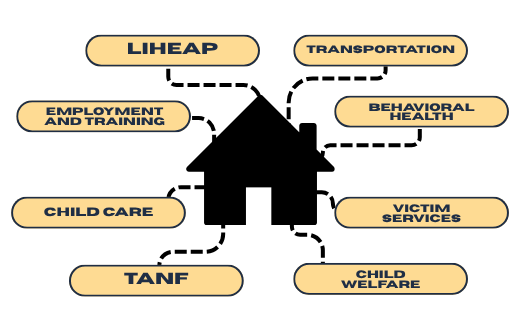
Most of these barriers weren’t intentionally created. They are often the result of programs developing separately over many years. Federal funding plays a big role in that. Tribal governments may receive funding from several different agencies to serve many of the same families, while each funding source comes with its own rules, deadlines, eligibility requirements, and reporting obligations. The challenge for Tribal staff is taking all of those separate requirements and turning them into an experience that makes sense for the person sitting across the desk.
I also think it is important to be careful when we talk about tribal service coordination. Better tribal service coordination does not mean every department should have access to every piece of information. There are records involving child welfare, courts, domestic violence, behavioral health, finances, and other sensitive matters that absolutely need appropriate protections. Tribal Nations also have their own laws, policies, and expectations governing how information should be handled. The goal should not be to eliminate every wall between programs. Some walls are there for a reason. The opportunity is to figure out where separation protects people and where it simply makes it harder to serve them.
Sometimes better coordination may be as simple as allowing an employee to see that another program is already helping a family without seeing the confidential details of that case. In other situations, it may mean creating a better referral process between departments or giving leadership a broader, aggregated view of community needs. That broader view can be extremely valuable. One Tribal department may see an increase in requests for food assistance. Another may see more families struggling with housing. Another may see growing demand for behavioral health services. If those programs are viewed completely independently, those may look like three separate issues. Taken together, they may tell a much bigger story about what is happening in the community. That kind of information can help leadership decide where resources are needed, identify gaps in services, pursue funding, and plan for the future.
Technology can help with some of this, but I don’t believe technology should determine how a Tribal government operates. The opposite should be true.
The Tribe should decide how its programs work together, what information can be shared, what needs to remain separate, and who should have access. The technology should be flexible enough to support those decisions. That is something I have come to believe strongly through our work with Tribal governments. There is no single model that will work for every Nation, and there shouldn’t be.
Some Tribes may want programs to remain largely independent. Others may want closer tribal service coordination across several departments. Some may create a more integrated family-services approach. Those decisions belong to the Tribe.
For Nations interested in looking at this issue, I don’t think it necessarily has to begin with a major technology project or organizational restructuring. It could begin with a much simpler exercise: follow the experience of a family that comes to the Tribe for help. Where do they have to provide the same information more than once? Where are employees relying on phone calls, email, spreadsheets, or personal relationships to make referrals? Where do confidentiality rules appropriately prevent information sharing? Where are there opportunities to make things easier without compromising privacy? Those questions can uncover a lot.
There is a great deal of discussion right now about how the federal government, Tribal Nations, and service providers can improve outcomes for Native children and families. Programs and funding will continue to evolve, but I think one principle should remain consistent.
The people being served should be at the center of the system. A child is not simply an ICWA case. A parent is not simply a TANF case. A survivor is not simply a victim-services case. They are people and families whose lives often cross many of the boundaries government programs use to organize services. Those boundaries may be necessary, but they shouldn’t make it unnecessarily difficult for people to get help. If Tribal governments can make those connections easier while still protecting sovereignty, privacy, and program integrity, that seems like progress worth pursuing.
How RiteTrack Can Help
If your Tribe is looking for ways to improve tribal service coordination across programs while still protecting privacy and program-specific information, RiteTrack can help support that approach.
RiteTrack is configurable to reflect how your programs actually operate, including what information should be shared, what should remain separate, and who should have access.