1997 and Today: Thirty Years of Change—and a Moment That Still Feels Close
By Even Brande
In some ways, 1997 feels like a very long time ago. It was not just another decade; it was another century and another millennium. And yet, from my perspective, it does not feel all that long ago.
That was the year I turned 30 and thought, It’s now or never if I’m going to start my own business.
The circumstances help explain why I was thinking that way. The software company I had worked for over the previous four years—my first “real” job—had just been sold. My wife owned a fourth-generation family business, and we were settled in Laramie, so moving was out of the question. We were also thinking about starting a family.
I had learned the ropes of running a software startup from my mentor, Dr. Brooks Mitchell. I knew a thing or two about programming and databases, too. Put those pieces together, and starting a software company seemed possible—even if it was a little unthinkable.
Today, if someone asks me about the risks of starting a tech company, I warn them that the odds are tough. I later came across the often-repeated estimate that about nine out of ten tech startups fail to reach their tenth anniversary. Fortunately, no one gave me that warning in 1997. Young, naive, and full of optimism, I had just enough knowledge to take the leap. So I went full steam ahead with a little startup.
Three Decades of Change
When Handel began in 1997, the “dot-com” race was underway. It would end in a spectacular crash a few years later. Over the course of Handel’s first 30 years, technology has gone through three major shifts that have transformed daily life: the widespread adoption of the internet from the mid-1990s into the early 2000s; the rise of mobile devices and wireless internet, which continues to reshape how we live and work; and now the rapid growth of artificial intelligence, whose effects are still unfolding.
It’s worth pausing to remember what everyday life looked like in 1997. According to the Global Policy Forum, only about 2 percent of the world’s population had internet access. Most communication happened through physical mail, fax machines, and phone calls. Business meetings were generally held in person. We watched movies in theaters or rented VHS tapes from Blockbuster. We listened to the radio and compact discs. We moved computer files on floppy disks. We took photographs on film and waited for a photo lab to turn them into prints. And money usually changed hands in cash or by check.
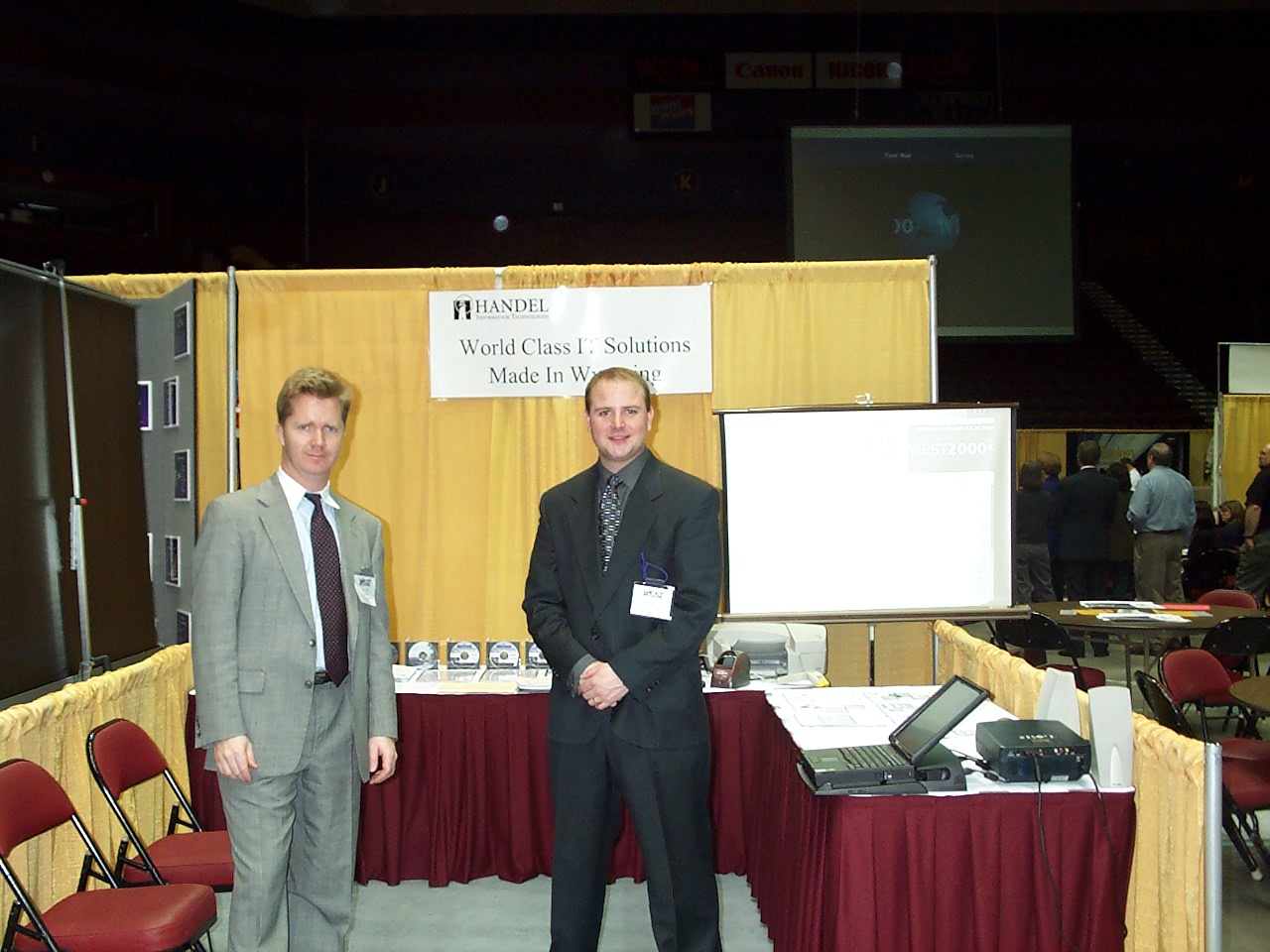
An early Handel IT trade show booth, showcasing the company’s software solutions and its Wyoming roots.
Fast-forward to 2026, and the world looks very different. We rely on mobile devices and the internet for much of what we do. Many of the everyday experiences that were analog in 1997 now have a digital counterpart. Music, movies, photography, and communication by text, voice, and video have all been transformed.
And technology has created experiences we could hardly have imagined in the 1990s. Physical things have not disappeared, of course. I still print photographs and send Christmas cards. But I suspect many people do those things less often than they used to.
Looking back, 1997 can feel impossibly distant—and surprisingly close—at the same time. The world around us has changed in ways I could not have predicted when I started Handel. But that 30-year-old version of me, wondering whether it was time to take a chance, does not feel like a stranger. As we approach Handel IT’s 30th anniversary in 2027, I find myself thinking about both sides of that journey: how much has changed, and how it all began.

Handel IT founder Even Brande (me!) at a RiteTrack Conference in 2000, during the company’s early years of growth.
A Few Things That Haven’t Changed
Today, a one-person business working from a basement can use AI to build software solutions in hours or days. In Handel’s early years, that kind of work could take months or even years. Does this create an existential threat to established technology companies? I like to think not—and here’s why.
One thing has not changed in 30 years: people. We are still much the same as we were in the 1990s. In building a successful technology business—or any business—it is people who make the difference. Our business is still a people business.
Handel’s success has grown from 30 years of building long-term relationships with our clients. In government software, the procurement process demands patience. It can take three years or more to move from an initial lead to a signed contract. AI may help with parts of that process, but it cannot replace the trust, proven results, patience, and tenacity required to build lasting relationships. Those are all people-centered qualities.
The things that have brought Handel through 30 years have little to do with the technology itself and everything to do with the people at Handel: our values, our home in a less traditional technology hub like Wyoming, and our grit, frugality, patience, and perseverance. Those qualities are why we are here today—and why we look forward to the next 30 years of this journey.
Technology will no doubt keep changing at an accelerating pace. Our customers’ needs, and our employees’ commitment to meeting them, will remain at the heart of what we do.