


When the Multi-County Juvenile Detention Center in Ohio decided to implement a new case management software system two years ago, they had several goals in mind:
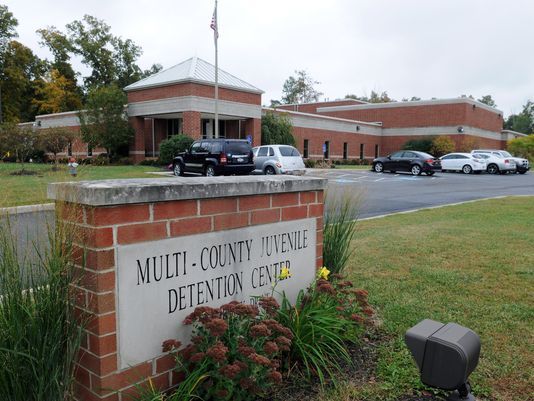
The MCJDC is a 48-bed facility that serves boys and girls. They accept youth from four Ohio Counties: Fairfield, Licking, Hocking, and Perry. In the fall of 2017, Multi-County chose the RiteTrack Juvenile Case Management software from Handel Information Technologies. The implementation project kicked off in late October 2017 and Multi-County went live on their new system on January 1, 2018.
During a recent webinar, Steve Koenig from Handel sat down with Dana Moore, Multi-County Superintendent, and Bret Sark, Deputy Superintendent, to discuss their experience with RiteTrack (RT) some 15 months after going live.
The following is a summary of some of the key takeaways from this conversation. Some of the wording has been paraphrased for clarity and in some cases similar topics have been grouped together.
Multi-County is required to report back to various stakeholders. With the old process it was very tedious and sometimes outright difficult to find, collect, and report back good information.
The old process consisted of many disjointed systems including multiple Excel spreadsheets, paper forms, and a case management database. In many cases, one employee may have a specific spreadsheet for specific information that would not be shared with others. According to Dana Moore, when someone requested information or staff needed information there was generally a lot of time wasted running around looking for the data or even finding the person who had the statistics. “It was not only difficult gathering the information we needed to make decisions and to provide services to the youth served, but it was also very difficult compiling the necessary reports required both internally and externally,” she says.
“With the new system, we have instant access to all the information we need at our fingertips. When someone calls for information we no longer have to say ‘Hold, please; we will get back with you.’ We can give instant answers, and we now have high quality information readily accessible so that we can make decisions in real-time.”
RiteTrack also gives them a battery of standard reports as well as reports specifically customized for them so that they now can provide feedback to their stakeholders with the click of a button.
Dana and Brett repeatedly mention the importance of having a centralized, web-based system, where data is available in real-time. Yet, security for sensitive information is also vital. Access to the centralized system is set up through different security groups so that individuals logging on to the system have access only to the information required for them to do their jobs. For instance, law enforcement personnel may just have access to basic client demographics, whereas a shift manager may access incident reports, restraints, and room-confinement information.
The focus of this initial phase has been on the intake process which is the heart of their operation. Dana says they were surprised to find out how many of their needs were met by RiteTrack “directly out of the box.” They had initially expected that they would need to do several customizations but decided to dive in and discover what RiteTrack could do for them at the start. What they found was that RT right away met most of their needs and so they were able to keep customizations to a minimum.
“There isn’t any information from our facility that doesn’t go into RT somewhere,” says Dana. She believes that having all this information allows staff to be better at time management which makes them more efficient and which ultimately leads to better decision-making.
Another key benefit Dana mentions is RT’s ability to export data to Excel. Since all staff are very familiar with Excel, this is of great value. RiteTrack gives them a centralized system for all their data but they can still export to Excel and do further data analysis as needed.
A further benefit Dana declares is that their paper consumption has been cut in half since implementing RT. Not only that, but they have been able to scale back their copier contract also and these translate to some significant financial savings.
Brett additionally explains how some of the reports in RiteTrack have helped improve the quality of information. “The Missing Data Report gives us direct insight into what important data fields our employees may miss, and we can catch those mistakes and correct them. In the past these have gone undetected and have caused problems down the road. Having access to staff information, attendance, and performance records is also very valuable.”
Multi-County went live after only two months of implementation work. Dana credits this speedy process to their willingness to see how much they could use the system right “out of the box” and not to over-customize RT. “Once we dived in, we actually cut in half what we thought we needed to customize,” she says. She strongly emphasizes the importance of plunging in rather than doing too much speculation as to what an agency may want. She recognizes that change is hard, and most employees don’t like big changes. Yet, she has found that her employees picked up RiteTrack very quickly. “It is so intuitive,” she adds. “After just basic training, our employees figured it out. It also helps that the system is organized very logically and that it guides us through the intake process step-by-step.” Talking about the go-live date on January 1, 2018 she readily says, “We didn’t have a single glitch that first day. All of our data was there and our reports were spot on.”
Dana and Bret also credit Handel’s Project Manager, Jeanne Wolcott, and Steve Koenig for being instrumental in their success. “There were times when it would have been really easy to hit the panic button had we not had Jeanne on the other end to guide us and give us ready answers. When we needed help, she would jump and do a screenshare, showing us how to do things.”
“During the week that your staff spent here at the initial kick-off, you pulled in someone from every side of the facility to answer questions such as: What are your needs and what do your reports look like? You were able to understand our needs and then demonstrate how RT could meet those needs. I can’t imagine a better process. That was huge. Everyone felt valued and it was a big part of getting everyone’s buy-in. They felt that they were heard.”
“The success for us was the team you provided. It made the transition very seamless and positive. Doing the project in smaller phases is also something I strongly recommend.”
Brett and Dana are both very complimentary about their experience since going live in January 2018. “Handel’s support is absolutely first class.” When asked about the biggest difference between their former vendor and Handel, Dana doesn’t hesitate, “With the old vendor, there could be days of emailing back and forth before we could get an answer. With Handel we get an immediate response when we call—evenings, weekends, or even holidays. It doesn’t matter. Jeanne is always there for us.”
She brings up an example of a recent incident. Ohio Department of Youth Services recently visited them and needed a report in a very specific format. RiteTrack didn’t have a report in the exact format they needed so they called Handel. Within one hour they had their report. “This is almost unheard of,” Dana recounts.
As Multi-County continues to realize the immense impact RiteTrack has had on their operations, Dana says she is making plans for future expansions. “Our next goal is to expand RT into the clinical area so that our medical department can use it. We also plan to implement support for the Topaz signature pad.”
“When a mandate comes down requiring some new report, we have the confidence that RiteTrack can provide the answers.”
Juvenile facilities across the country have opted to work with Performance-based Standards to assist with monitoring confinement conditions in treatment services and residential facilities using national standards and performance outcomes.
PbS is a data-driven improvement model grounded in research that holds juvenile justice agencies, facilities and residential care providers to the highest standards for operations, programs and services.

Twice a year juvenile facilities compile data from day-to-day case management (including incident reports) and enter it into the PbS program interface. The PbS system then analyzes the data to assess whether the facility is meeting performance outcomes and uses this data to create summary reports. These analyses are used to create improvement plans and direct needed reforms in a facility.
Often during the months of April and October, many facilities who partner with PbS for this valuable service struggle with the time it takes for staff to perform daily responsibilities and reenter collected data into the PbS system.

However, in 2017 Handel met PbS at the Michigan Juvenile Detention Association (MJDA) Conference. Both of us saw the potential of a partnership between our two organizations. Over the next few months, we created a RiteTrack module that enables the PbS analysis system to integrate directly with RiteTrack’s case management and reporting solution which eliminates the duplicate data entry staff had to complete for the required reporting periods.

This RiteTrack and PbS integration enables juvenile detention and juvenile justice organizations’ staff to enter daily documentation into one case management system, RiteTrack—which also produces user friendly and reporting for other facility needs—while the integration module imports the required information directly into PbS’s system for the bi-annual reporting periods.
RiteTrack’s juvenile justice module captures required information like incident reports for PbS reporting. Because of the aligned data capture in the systems, information documented in RiteTrack is submitted to PbS through the one-of-a-kind integration module and eliminates duplicate data entry—saving detention staff and administration valuable time.
Contact us if you would like more information on the PbS and RiteTrack integration module or RiteTrack’s solution for juvenile justice and detention facilities.
If you missed the live webcast, click here for a recording that looks at the specific intake and risk assessment functionality available in the RiteTrack juvenile justice system.
Every size of facility from 10 beds to 100 or more beds must follow the same first step when a youth arrives: completing an intake process.
Many facilities also require some type of risk assessment as part of this process.
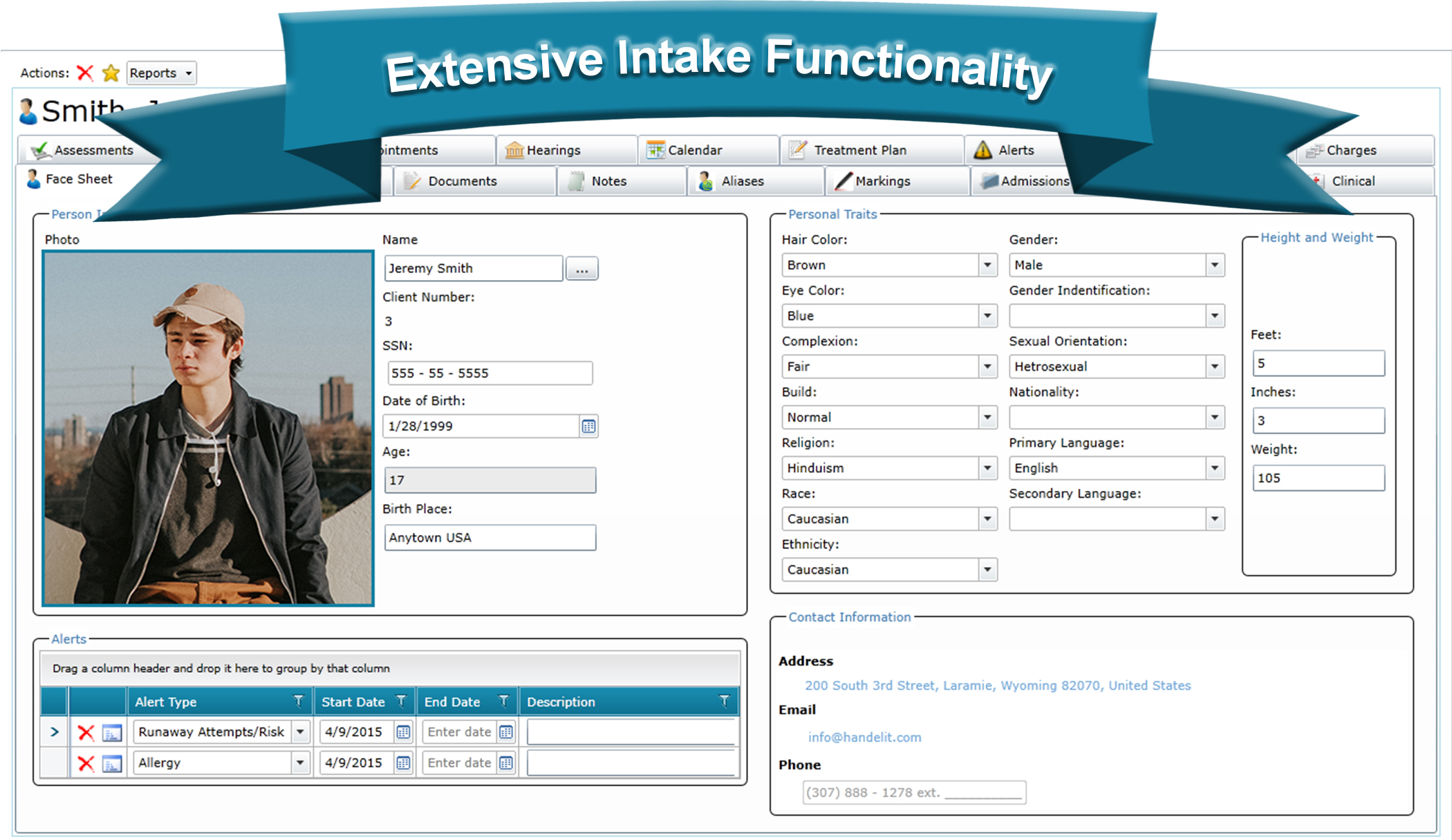
During this recording–showcasing a system which was designed with the needs of juvenile facilities at its heart–you will see the functionality that assists juvenile organizations with intake processes no matter the size or caseload.
If intakes and risk assessments have incorrect information or are incomplete, it complicates the admission process creating extra work for staff and administrators alike.
The extensibility of the system enables organizations to complete risk assessments within the software’s interface and can generate an easily digestible summary of the assessment data.
We covered the following items:
An information and case management system such as this ensures data is accurately entered, easily accessible, and simply reported on.
 If you were unable to attend the recent webinar on how RiteTrack is used for data generation in juvenile justice programs and system-of-care programs, you can now view that recording here.
During this webcast, Steve discussed the challenges facilities and system-of-care programs face when trying to generate reliable data to inform stakeholders of trends, issues, and successes.
He examined software that provides the day-to-day operations of a facility and showed real-world examples of how to utilize juvenile-specific data to improve decision about the youth in care and the operations of the facility.
Reports illustrated include:
You can also see best practices to use the data to inform decision-making by:
Kitsap County went live on RiteTrack in January 2017. In this video clip, Michael Merringer, Director of the Kitsap County Juvenile Court Administration talks about the implementation of RiteTrack, it’s impact so far, and what it is like to work with Handel.
When reviewing DMC aspects, in my mind I kept coming back to the issue of how much needs to be encompassed when implementing and maintaining DMC standards into a juvenile justice program. These standards incorporate assessments, evaluation, and monitoring of juveniles in care. However, DMC doesn’t only apply to youth in detention. It really incorporates all areas of youth contact within the juvenile justice continuum of care.

Example of statistical report with DMC data.
Often DMC communities may have an alternative reporting center within it. I’m curious to see how information is communicated between one part in the juvenile justice continuum of care with another part. There is the potential for an enormous amount of time to be spent creating policies that address information sharing parameters, managing confidential information, and memorandums of understanding between these organizations. Even though data points like race, ethnicity, gender, geography, and offenses seem straightforward, these would likely need to be clearly defined with consensus from members of the continuum of care.
So how can organizations or programs in the juvenile justice continuum of care address information challenges like these? Using a web-based software like RiteTrack as the single-point-of-entry tool provides the framework from which programs can support the youth and the stakeholders.

Risk Assessment tool in the solution.
For a community to address DMC, there has to be involvement from shareholders in the community. There has to be planning and agreement on issues. Organizations must develop intervention that involves programming. Agencies need to evaluate whether the agreed upon plan is working. Finally, programs must be monitored to make sure that identified problems area continued to be addressed. Within all of these steps, the most important area may be the collection of data because youth data is pervasive in all these steps. RiteTrack collects data that occurs throughout all point of the juvenile justice continuum from first point-of-contact, risk assessment, community involvement, and if needed detention. In addition to extensive documentation, RiteTrack quickly generates reports and statistical data based on real-time data that is accurate and reliable. Implementing RiteTrack into operations is not just a procurement or download of another piece of software. It is a partnership with Handel IT to enhance and improve communities, not only by supporting a continuum of care, but also by creating a central point-of-entry to provide the framework to address DMC issues.
To see my most recent webcast reviewing DMC functionality and reporting in RiteTrack, click here and register to watch the recording.
 The JDAI helpdesk website states, “Since 1992, the Juvenile Detention Alternatives Initiative, a project of the Annie E. Casey Foundation, has demonstrated that jurisdictions can safely reduce reliance on secure confinement and generally strengthen their juvenile justice systems through a series of interrelated reform strategies.”
As you may know, I was a former Director of the Perry Multi County Juvenile Facility (a juvenile community  correction facility in Ohio) and our focus was on treatment of juvenile, male felons through a cognitive-based treatment program. I do want to point out that I am not an expert in Juvenile Detention Alternative Initiative (JDAI) standards; however, in my current position with Handel I have become
  much more familiar with them. JDAI standards closely align with the American Correctional Association (ACA) standards and they incorporate the Prison Rape Elimination Standards (PREA) as well. Both the ACA and PREA standards are areas that I am very familiar with having completed two ACA audits and a PREA audit.
As revealed in the JDAI Detention Reform Brief Cost-Saving Approach, some of the JDAI strategies are to increase system efficiency, develop a non-secure alternative that is less expensive than detention, help keep kids out of state facilities and help explore the most cost-saving intervention for a youth. From my experience in a juvenile facility, I know first-hand the ease with which the juvenile correction community easily faults to the “Well, that’s the way we’ve always done it…” or “That’s just the way it’s done.” I was a process-oriented director and one of my skills was to always look at why we do something and if we could do it better. I think that is why I am intrigued to learn (from my exploration of JDAI) that a focus seems to be to look at problem solving differently and to focus on different options and outcomes beyond the traditional way of committing youth to detention.
However, I am not here to give you more information about the JDAI standards. I want to tell you about a software solution that can greatly help facilities recognize and implement the JDAI strategies in their communities and better manage their cases and facilities as well. This solution is RiteTrack and it is juvenile facility software that assists in 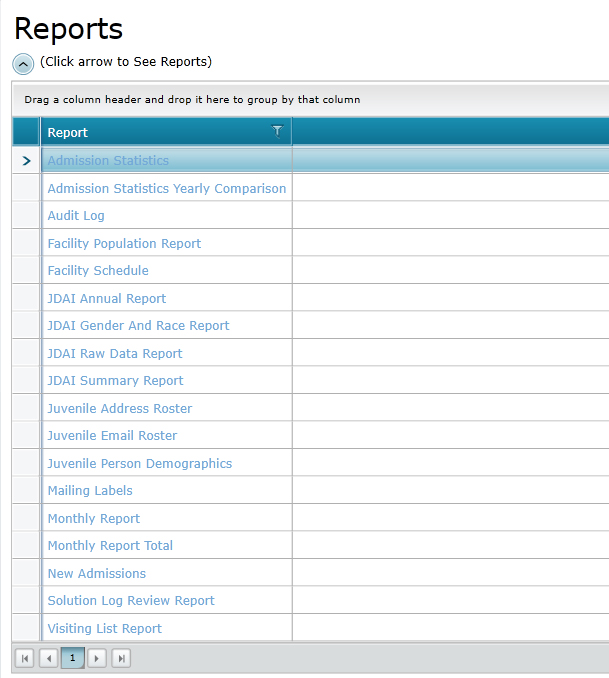 managing your facility and the youth in that facility. It is equipped with a powerful reporting module that can incorporate many of the JDAI required reports. Additionally RiteTrack can also assist the JDAI local community that is responsible for entering, collecting and generating data to address compliance with the JDAI standards. RiteTrack is a software system that tracks common functions like incident, restraint and room confinement documentation, along with common practices of treatment plans, group notes and room assignments. RiteTrack excels as a facility and youth management system while allowing you to generate JDAI data not only from a juvenile facility level but also to a functionality level that compiles JDAI data for a whole JDAI community.
I will focus on three points about RiteTrack and JDAI: generating and managing data, using data to make decisions and managing the facility.
Point 1: Generating and Managing Data
Data is an essential component of JDAI, and it only makes sense that you have to generate data as the first step before you can analyze and use that data. While JDAI encourages the person or persons who share(s) the responsibility of data generating to use the simple format of Excel, it is not the most effective or efficient method. JDAI might recommend Excel because so many people have access to it; and in a JDAI community, the data come from many different areas and levels. Data generation has to occur at the probation officer level, the court level, the community alternative placement level, detention level and other agencies such as community mental health or community drug and alcohol treatment organizations that may be involved with the youth. So there is a possibility that you have many different organizations collecting data that then have to be transferred or given to one centralized “data collector” to process and manage. RiteTrack can play a very important role in this “collection” by acting as the central point of entry.

RiteTrack allows youth to be entered into the system and then additional data added to the youth’s record. Once information is added to RiteTrack then it is saved and will stay with the youth throughout his/her involvement in the process, even including if the youth is placed in an alternative placement or detention. Data such as race, gender, age, geography, prior placements, prior and current criminal offence, offence type, involvement with child welfare, involvement with substance abuse treatment and length of stay in detention are all areas in which data needs to be collected for JDAI standards. RiteTrack offers all those components as standards within the basic RiteTrack system, so a youth’s record in RiteTrack can contain all this information (generated by various agencies involved with the youth) in one record in one place. Additional areas that are important such as risk assessments, which are done either on paper or in another system, can be added to the RiteTrack system so that all information that is collected on a youth is stored and accessible in a centralized data collection location. This whole set of data can be recalled or opened at any time by qualified RiteTrack users. RiteTrack is a web-based solution that is easily accessible with internet access, so long as the user passes security clearances set up in each facility system.
Point 2: Using Data in Making Decisions
We all are aware of the trends in juvenile justice to use evidence-based practices to make decisions based on data. Decisions should not be based on how we feel or what is available, but they should be objective tools to assess level of risk. JDAI suggests that we evaluate data on a regular basis (e.g., daily population counts of youth in detention, quarterly reports and continual review of the data collected such as race, gender, age and geography). Therefore, data must be gathered and analyzed throughout the process and throughout the community that is involved in the JDAI. Data analysis can help shareholders decide when and if an effective community-based alternative would be appropriate. Data analysis can assure that detention is used only when appropriate and only for those youth that are high risk of reoffending. Data can assist in determining bias in the system based on race, ethnicity, gender, sexual orientation and geography, among others; and determine if there is “institutional bias” within the system. Only when we see the data over a period of time can we make good decisions.
RiteTrack allows for all data, generated by a JDAI community to be stored in a centralized location and readily available to help in the decision-making process and JDAI reporting. Such a system is more cost effective and more efficient, and allows easier tabulation of data, which facilitates a better, more streamline decision process for the youth in a JDAI community.
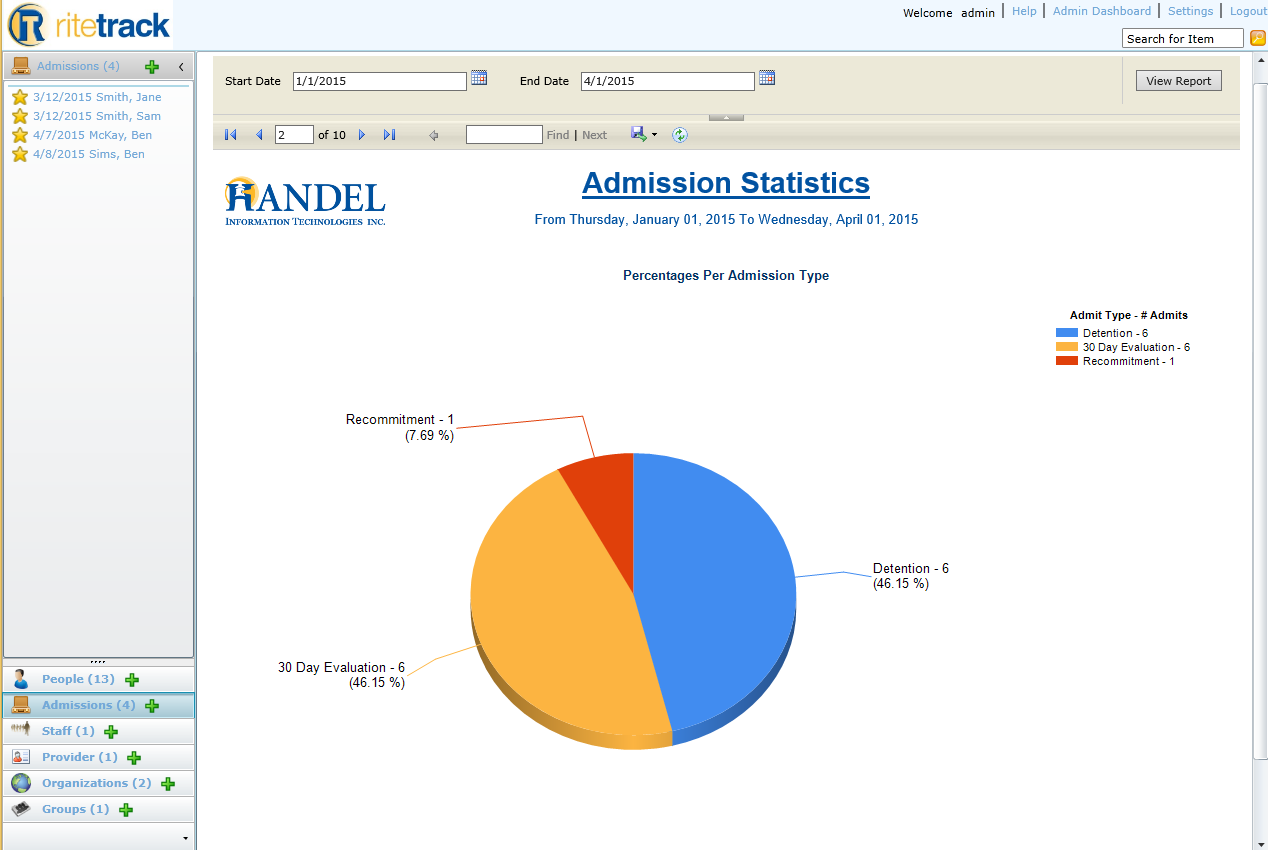
Since RiteTrack is also facility software, data generated from youth being in the facility (i.e., number of incident reports, number of restraints, time in room confinement, number of hours of group participation, and facility population reports) can also be used to make decisions and determine a youth’s progress while in the facility itself.
Point 3: Managing a Facility
To participate in JDAI a facility must track and report on the following: race, ethnicity, gender, age, geography, placement history, child welfare involvement, mental health, substance abuse, education, family history, housing, prior offences, probation status, offence and offence type, aggravating factors and length of stay in detention.

RiteTrack tracks all of these data points. Each of these points are collected and tracked via drop-down menu options that are accessible and may be customized by a system administrator. In addition, many of these points have models in RiteTrack that allow for input of descriptive narratives. For example, tracking aggravating factors would most likely involve a short story or description of the aggravating factors. Workers unfamiliar with a youth would need to see what led to, or what is being described as the aggrieving factor in the incident entry. Therefore, through progress notes, RiteTrack tracks the number of incidents as well as descriptive elements.
Finally, in addition to collecting, tracking and reporting all the youth personal and participation data for a facility, RiteTrack also functions as a case management and facility management module. RiteTrack, as a case management system, encompasses treatment plans, progress notes and demographic information. As a facility management system it includes functions such as shift reporting, inventory management and incident, restraint and room-confinement reporting. RiteTrack complies with the common practices of attaching pictures, reports, video clips or tabulation of hours and minutes of room confinement time to the data entries. RiteTrack also provides a due process model, which is required for grievances, and which demonstrates compliance with due process related to major incidents within a facility. The RiteTrack design of both a case management model and facility model incorporated into one solution, allows for data reporting from both “parts” of the RiteTrack system.
RiteTrack offers the ability to generate data for the JDAI community while also serving its primary focus as juvenile facility software that manages a facility and the youth within the facility. Doing all this as a single software system, RiteTrack is an effective, efficient and cost-saving approach for any community and facility participating in the JDAI standards.
To see a demonstration of the RiteTrack system and to see how RiteTrack can assist your organization or community in compliance with the JDAI standards, please give me a call at 740-994-0500 or send me an e-mail with any question you may have at steve.koenig@handelit.com
My personal introduction to Handel IT and the RiteTrack software system (see my previous blog) was in no small part due to the topic of seclusion. While the topic of seclusion and room confinement is bigger than RiteTrack software, seclusion has become a big issue for juvenile and adult facilities in Ohio and across the country.
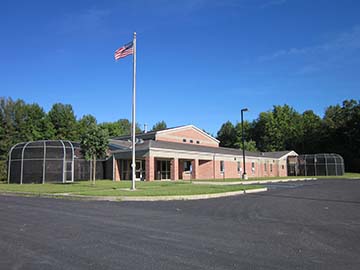
Perry Multi-County Juvenile Facility in New Lexington, Ohio
As the former director of the Perry Multi-CountyJuvenile Facility, I served a mandate to provide rehabilitation to juveniles in a correctional setting, rather than a punitive punishment in an institutional setting. I firmly believed that seclusion, as a form of punishment, was detrimental to our philosophy of assisting and helping youth. In short, if you locked a juvenile in a room (seclusion), how would you expect him to reintegrate into a therapeutic treatment model without unintended consequences such as an unwillingness to engage in a treatment program? My belief is that seclusion, used solely as punishment, was counter to a treatment philosophy of engagement and making better choices. Although as a director, I also understand that there were times in which the only means of protecting an individual youth, my staff and the facility as a whole was seclusion. These issues of when is seclusion necessary, when is seclusion needed, and when does seclusion become a punitive issue are concerns that all directors deal with in our profession. They are also issues that, at some point in time, we have to give answers to for why we did what we did and why we made the decisions we made.
When I had to provide a total of the number of seclusion hours for 2013 in our facility, I believed that my total number of hours would be pretty low (fewer than 100 hours). After all, I opposed room confinement as a form of punishment. After we compiled the numbers, I was surprised to learn that I had signed off on over 300 hours of seclusion for my youth during 2013. That is more than three times my original estimation, and that high number made me re-think my role as a director. Not only had I not stayed true to my principle that seclusion had to be used on a very limited basis, but also my standard had not been transferred to my staff in a way that put that principle into practice at our facility.
In April of 2014, two months after collecting that seclusion data for the state, I watched a PBS Frontline special presentation on seclusion in the Maine State Prison. Prison Warden, Rodney  Boufford, was actively attempting to reduce seclusion hours for his inmate population. While I understand that the inmates Warden Boufford was dealing with were much different from the juveniles I was dealing with, the topic of seclusion is still very relevant. It was very interesting to see the inmates in Maine and hear what they were saying, while also hearing from the warden, supervisors, line staff, psychologist and others who oversee them on a daily basis. I was surprised that the idea of reducing isolation was even present in a state institution with very violent and aggressive felons and a generally negative-thinking atmosphere. However, they were not only thinking of reducing seclusion hours; they were beginning to implement it. The show takes about an hour to watch, and I recommend it as an important segment for those involved in corrections.
The Frontline special and new statistics required by the state of Ohio got me thinking. Am I, as an administrator, doing enough to reduce the confinement times in my facility, and do our policies as a facility reflect our need to reduce confinement time? At our monthly supervisory meeting a few days after watching Frontline, I addressed the need to revamp our policies and procedures and to eliminate room confinement as an issue of punishment and time and as appropriate only in cases where the safety of staff and others is at risk. Our current policies were time-focused (i.e., one incident equals so many hours of confinement). Our new policies would be behavior-focused whenever youth were complying and there was no documented threat to the safety of the staff or other youth. The new policies would encourage youth to begin the process or re-engaging into the general population and everyday activities. Because the facility activities were meant to be therapeutic and if you could get the youth to engage in therapeutic opportunities, then you could begin treatment.
While my ideas were agreed upon overall, there were many who expressed reservations. I heard concerns such as the changes I championed would “harm the staff and would make youth believe that we were not serious about dealing with behavioral issues.” Some felt that if we made these changes, focusing on reducing room confinement, that “someone, another youth or a staff member would be hurt.” I listened to all of their issues and then I encouraged my supervisory staff to view the video and then come back to me with their thoughts. I also asked each one of them to estimate  the number of seclusion hours that they believe we had accumulated in 2013. I had not given them our actual number, but I had used the number of 300+ seclusion hours as my example. Every single person asked gave me a number that was much lower than that. So I challenged them to watch the video to see what they are doing in the State of Maine and then to tell me why we couldn’t do the same thing in our facility. I also told them that the number of seclusion hours that they all had estimated for 2013 was a very different number than what we had actually accumulated. My point was that we thought we were doing well, but the 2013 seclusion hours showed me that as a group we had failed.
At our next meeting we addressed the topic of seclusion and this time there were very few detractors. All the supervisory staff agreed that we needed to reduce our confinement time, and that we needed also to continue to do our duty to protect the other youth and the staff and maintain the therapeutic environment of the facility. To do all those things we needed to create a balance between protection and seclusion. That balance needed to be evident in our policies and procedures, as well as in our thinking and in our implementation. We agreed that if we could create a balance, then we would better fulfill the need and responsibility for both safety and treatment.
The topic of seclusion was also very relevant in Ohio at the time. The Ohio Department of Youth Services was under federal monitoring for various reasons, and nearing the end of the monitoring the issue of seclusion or room confinement became a concern. The state began addressing how it could reduce seclusion hours of youth. In addition to its being a valid issue, it was also a requirement for “getting out from under federal monitors.” Recently Ohio Department of Youth Series was released from the lawsuit and has made very progressive and needed changes in seclusion hours.
See these two articles: Lawsuit over: Everyone won and Judge ends federal monitoring monitoring of Ohio’s youth prison system
The article above from the Cleveland Plain Dealer reports: “The state has also dramatically rolled back its use of solitary confinement – also called ‘seclusion’. An infraction that brings 8 hours of seclusion now would have been punished with 600 hours of seclusion when the lawsuit was filed, according to Cynthia Coe, a U.S. Justice Department attorney involved with the case.”
I was surprised when I read those numbers and remember having to re-read the paragraph again. “…infraction that brings 8 hours now would have been punished with 600 hours.” This was the trend in corrections in adult and juvenile systems just 7 years ago. I was amazed at how “behind” we as a corrections community were, but also pleased with how far we have come.
Looking back, I wonder if I would have addressed the issue of seclusion quicker in my facility if I had had valid data that would have given me a better understanding of seclusion hours. In the recent JDAI reporting the finding suggested the following:
“’The revised JDAI Detention Facility Standards prohibit the use of room confinement for discipline, punishment, administrative convenience, retaliation, staffing shortages, or reasons other than as a temporary response to behavior that threatens immediate harm to a youth or others,’a JDAI summary of strategies to eliminate unnecessary use of room confinement states.” -Juvenile Justice Information Exchange
The JDAI recommendations and goals also address the topic of using data to make informed and educated decisions. If I had a RiteTrack system in my facility just two years ago, I wonder if I would have been more progressive in my decision-making because of the quality data and better statistics generated from the solution to help support better-educated decisions. Because not only would I have had up-to-date and valid data for the day, months and year, but I could have been tracking the data more effectively rather than relying on an end-of-the-year report.
I believe that many of my former colleagues share my belief that room confinement is necessary, on a limited basis, especially due to the nature of the work we perform. However, I also believe that directors and administrators want to always balance the safety of the facility without violating the rights of our youth. With a balance of protection and safety of rights in our policies and procedures and implementations, we can achieve the ideal of safely treating and serving troubled youth. The RiteTrack software system can and will assist administrators in creating that balance at their facilities.
In our more than a decade-and-a-half of experience in the juvenile justice field, we have found many, many pieces of our software can be used with no modification whatsoever for every facility we work with. However, there is one piece that always seems to require customization. Each facility has its own unique layout and its own individual room configuration. As anybody who has worked on a software implementation can attest to, customization means an increase in scope and cost.
If each facility requires a custom room assignment module in its facility management software and custom software development leads to higher costs then the inevitable conclusion has been that this type of software is either expensive or impossible to obtain. So, the question for any organization historically has been which do you sacrifice? Your budget… or your software functionality?
Fortunately, at Handel we strive to provide standard solutions in order to reduce the cost of our product and the ever present risk of scope creep. We have worked to develop a system that is flexible enough to adapt to any facility, big or small, yet retain enough standard functionality to maintain the rigid standards required by juvenile justice facilities.
We have accomplished this with our innovative Facility Layout Management Tool. Below is an example facility that is split into separate living units.

Click to Enlarge
Each facility starts with its own “Base Building Unit”. Whether your facility is separated into pods, living units, wings, or buildings Ritetrack can take that verbiage and begin a virtual construction of your facility. Each of these Base Building Units may then be broken down into sub-units.

Click to Enlarge
In this example, Living Units are broken down into Rooms. However, your facility may use different terminology. As with the Base Building Units, sub-units may also be altered at the click of a button to match the existing terminology used in your current facility. In turn, each sub-unit may itself be broken down into more granular units if needed.
Additionally, different areas of a facility may have different layout configurations. For example, a standard living unit may be broken into separate wings while a supervision or medical unit may consist of a single area with beds. RiteTrack’s innovative functionality can build out these distinct layouts with no additional customization.
This flexible yet elegant design allows another powerful piece of functionality for users of the system. At a glance a RiteTrack user can see exactly what vacancies exist in the facility. In the second image Living Unit 100 is displayed with 8 rooms, each of which can hold one resident. Rooms displayed in blue are vacant and thus have one vacancy. Rooms displayed in purple currently have a resident assigned to them and thus have no vacancy in this example. Rooms displayed in black are closed rooms and are not able to house a resident. As we can see, at a quick glance, there are six vacant rooms in Living Unit 100, one room is occupied, and the last is closed and not able to house a resident. This logic is maintained for the entire facility layout and, as seen in the first image, can be scanned quickly by a RiteTrack user.
RiteTrack can utilize your current terminology, construct your facility in a virtual environment, and provide an overview of room vacancies at a quick glance. This is just the tip of the iceberg of room assignment functionality; there simply is too much to cover in one article. Future blog posts will cover how to assign rooms, how to close rooms to occupancy, and even manage multiple room assignments for a resident.
There is, however, one more piece of good news for organizations making the upgrade to RiteTrack. The Project Management and Development staff at Handel will oversee the virtual construction of your facility as part of our standard deployment process. This layout will be tested, verified, and users will be trained extensively in its functionality prior to the launch of your solution. From the very first moment of use your RiteTrack system will deliver this powerful functionality to your users.
Nobody wants to make the choice between blowing a budget and sacrificing quality. RiteTrack offers a way to avoid that dilemma. Ask to see a demonstration of our Facility Management software today.
Included, as standard functionality, in all RiteTrack Juvenile Justice Facility Management systems is the newly upgraded Visitation Module. This module not only tracks when a resident has a visit or a call from a friend or family member, it will also help prevent unapproved calls or visits from happening. RiteTrack provides this advanced functionality by first mandating that an individual receive approval prior to a visitation or call event. All requests for approval to call and visit are stored in a single location on every admission account to provide a single view for staff members to be able to add, update, and view information for that record. Consolidating this information is intended not only to save time and increase productivity, but also to make it easy for users to quickly determine whether an individual is allowed to have contact with a resident to prevent unapproved visits. Below is a view of our Visitation Approval screen.

Click to Enlarge
The example above displays a resident who has had two individuals request approval to visit or call during their admission. In addition to tracking names and approval statuses, RiteTrack also tracks the duration of the approval, as well as a comments section to provide users with additional information or alerts about potential visitors or callers. As seen above, Ben, our example resident, only has one person who is allowed to call. RiteTrack uses this information in the Calls screen to filter only those people who are allowed to call the resident.

Click to Enlarge
The functionality of Visitation Module is to help users screen calls and only allow approved callers to have contact with the resident. Only one caller has the approval to talk to the resident so only that person’s name is able to be selected from the dropdown menu. This functionality is designed to add one additional level of security for contact with a resident. Likewise, all visits a resident receives are tracked ona separate screen. Our example resident has no current approved visitors. As expected, this means that no name is selectable in the dropdown list to help users easily identify that a visit should not be allowed.

Click to Enlarge
However, if a visitor has been approved and that information needs to updated, RiteTrack accomplishes the change in a matter of seconds. All a user must do is approve the correct person, as seen below.

Click to Enlarge
And then the visitation record may be added.

Click to Enlarge
RiteTrack provides advanced functionality without creating a large additional workload for users. Many systems have sacrificed either functionality or ease of use to accomplish the other. Handel has provided a way to achieve both. Users provide above and beyond service for their residents; Handel believes facility management software should provide above and beyond service for users.
The center’s new course will help individuals develop effective and sustainable programs for reducing juvenile crimes and increasing youth potential in tribal communities.
Ramsey County, Minn. has partnered with Handel Information Technologies to implement a RiteTrack juvenile justice software solution to manage its juvenile detention and residential facilities.
The facilities using the powerful, new solution will be the Juvenile Detention Center and the Boys Totem Town.
“RiteTrack is capable of tracking the required data in a juvenile detention environment but also includes all of the functionality that the County’s residential facility needs for case and treatment planning,” said Dan Merth, Project Manager at Ramsey County Corrections Department.
Handel’s project manager said system planning and development is expected to last six-nine months with a flexible implementation timeframe of early 2015. “RiteTrack is designed well for projects where multiple facilities or departments are looking to merge their information sharing needs into one system. Through our proven track record with system design, data migration, and business and systems analysis even complex projects such as Ramsey County’s are launched and implemented quickly.”
RiteTrack will replace multiple systems; a legacy system which was created in an old programming language for the JDC which is no longer supported and a custom-built solution for the treatment facility.
The Mental Health and Juvenile Justice Collaborative for Change Web site says, “Providers rightfully tend to focus on meeting the needs of youth and families, but may fail to recognize the value of data collection and analysis. …In an environment in which demonstrating outcomes is critical, this oversight might be counterproductive.”
“The new RiteTrack system will generate real-time reports and notifications for case workers, administrators and stakeholders. The data collection and reporting capabilities will give the County high-quality information to produce client outcome information,” said Handel’s President Even Brande.
Ramsey County’s juvenile services provide “a structured and positive environment for the development of responsible youth with assistance from community partnerships and services within [the] County.”
RiteTrack, a Web-based juvenile justice software solution, tracks everything in juvenile diversion, detention, corrections and treatment cases from client demographics to treatment plans. This solution is designed to be the single point-of-entry into juvenile-serving agencies. As a youth enters a system, client information is entered into only one place.
Handel creates RiteTrack, a software solution used by juvenile service programs in state and county governments.
Handel implemented a new RiteTrack system for the Natrona County Juvenile Detention Center on May 13.
The newly implemented, juvenile detention case management solution contains functionality for case management, document management, case notes and a wide variety of reporting features. The RiteTrack system replaced the center’s previous paper-based tracking system.
In Natrona County various organizations work together to provide juveniles in need with services. These include community groups, the school district, district attorney’s office, Wyoming Department of Family Services, Department of Corrections, Sheriff’s Office, City of Casper Police, and the Juvenile Detention Center.
The local Project Manager, Amy Dorman, said “RiteTrack has allowed us to view information on the juvenile as a whole including family history, school history, legal background, jail admissions and any assigned groups. It takes time to assess what is really right for a youth.”
The RiteTrack juvenile module met the vast majority of the JDC’s needs right out of the box without much configuration work.
Handel Project Manager Ben McKay said, “The reporting feature in RiteTrack includes custom reports about daily case loads, client populations, client demographics, censuses and one for an attorney in the District Attorney’s office. The ability to collaborate between the JDC’s and DA’s offices is paramount, because the DA does client intake for the JDC.”
RiteTrack is a software solution used by human services programs throughout state, and county governments. It provides the primary means for caseworkers, administrators, and other professionals to manage clients and caseloads.
The Washington County Juvenile Detention Center, probation office and juvenile court work directly with youth who have been charged or sentenced for violating the law in Washington and Madison counties in Arkansas.
Essential information about offenders and services are often difficult to track on paper or with database software, but in order to distribute services to its facilities and provide rehabilitative programming for its residents, that data needs to be accurate and easily accessible.
The Washington County JDC and probation office found that its old database system and many other industry solutions provided the ability to combine and catalogue information from various paper sources and offered some reporting capabilities. However, the information in the database itself could not be shared between the JDC, the court and the probation office within the juvenile detention system. Meanwhile, the court and probation offices were operating without any software information management system and tracked everything on paper. The old database system also was not effective for repeat offenders because it created a duplicate client record for each repeated offense.
When Washington County began looking for a better software solution, it discovered RiteTrack. This solution provided the centralized database with a key benefit: the capability to share client information between offices without sharing sensitive case information. With RiteTrack the JDC, probation office (including prosecutors and public defenders), and court can all enter a new offender into RiteTrack and the other offices can then access the record of that offender.RiteTrack’s security parameters restrict case data viewing, but allow for client information sharing between departments. Therefore, all updates to the offender’s record made by an office are subsequently updated across all the departments.
Specific functionality of RiteTrack which is used by the probation and court side includes management of:
Now with consistent information for each offender throughout the system, all the offices are experiencing better information. This has increased productivity within each office and case processing has become more efficient as well.
The Washington County JDC is a multi-bed holding facility for both clients who have been sentenced and those waiting to be sentenced, but it also provides fee-based holding services for surrounding Arkansas counties.
Juvenile systems across the country can benefit from a RiteTrack solution. This offering is configured to meet any office or department’s specific information management needs. With better information management, juvenile facilities can offer more efficient services to their clients and can increase record reliability across departments and offices. Handel Information Technologies, the maker of RiteTrack, has 15 years of experience in providing software solutions to the juvenile justice field.
