Watch this recording of the Managing JDAI Standards and Reporting webcast.
Many juvenile justice communities strive to comply with JDAI standards but struggle with the required JDAI data collection.
During this webinar, we examined how RiteTrack increases your facility’s capabilities to measure, track and report on its JDAI efforts. We will also review how JDAI communities can utilize such a system to analyze data and formulate questions related to JDAI information. This comprehensive system provides the framework needed to help any facility adhere to evolving JDAI standards.
The secret lies in documenting and tracking this in the daily case management functions. RiteTrack’s JDAI reporting produces comprehensive reports for race, gender, age, and geography, as well as other requirements including daily population counts, quarterly reports, etc. Additionally, it compiles the required JDAI reporting in real time and eliminates a separate method of JDAI data collection.
Key features from the system that were demonstrated included:
RiteTrack’s sophisticated web-based interface and industry-best security model ensures only the right people have access to appropriate and relevant information from any location. Including JDAI compliance, standards and reporting.
So, whether you are running a county detention facility or a JDAI community, you should take a look at this offering because RiteTrack supports an emphasis on treatment and rehabilitation, along with resident and facility management.
If you didn’t have a chance to catch the webcast live, you can register to view a recording here.
In today’s world we have more data available to than ever before. Yet, few organizations truly understand how to harness this data and turn it into information and knowledge. During this webcast, we will define and explore how data analytics transforms data into meaningful information. We will also examine how Continuous Quality Improvement (CQI) can be applied to inform and improve services for families and children.
We examined the increase in the amount of data being stored over the last decades and the trajectory of the rise of data in our lives today. Even with data all around us it may not be collected accurately or in a consistent manner. Analytics and CQI depend upon quality data, and it is essential that leadership supports the collection and use of data with a sense of purpose and a vision of goals and benchmarks to measure. We will discuss reporting and information systems which may be used to collect data, as well as other sources of information available from Federal and State governments.
So how can Tribes make use of this practical information?

Using analytics changes this abundance of data into digestible information that can be used for many meaningful purposes. Comparative spreadsheets with raw data are one of the simplest ways of modeling data. Taking raw data and creating charts and graphs to provide useful visual methods of viewing and analyzing data and can be achieved with commonly used programs.
During this part of the process is where you create descriptive information using the data, then predictive intelligence, which leads to prescriptive knowledge that can be used to inform decisions and changes to improve services and outcomes. The philosophy of Continuous Quality Improvement (CQI) can be used to both ensure that data is accurately and consistently collected and as a method to analyze and react to the data. We will review in detail the cycle of CQI.
Register to watch here and email or call us with any questions.
When the Multi-County Juvenile Detention Center in Ohio decided to implement a new case management software system two years ago, they had several goals in mind:

The MCJDC is a 48-bed facility that serves boys and girls. They accept youth from four Ohio Counties: Fairfield, Licking, Hocking, and Perry. In the fall of 2017, Multi-County chose the RiteTrack Juvenile Case Management software from Handel Information Technologies. The implementation project kicked off in late October 2017 and Multi-County went live on their new system on January 1, 2018.
During a recent webinar, Steve Koenig from Handel sat down with Dana Moore, Multi-County Superintendent, and Bret Sark, Deputy Superintendent, to discuss their experience with RiteTrack (RT) some 15 months after going live.
The following is a summary of some of the key takeaways from this conversation. Some of the wording has been paraphrased for clarity and in some cases similar topics have been grouped together.
Multi-County is required to report back to various stakeholders. With the old process it was very tedious and sometimes outright difficult to find, collect, and report back good information.
The old process consisted of many disjointed systems including multiple Excel spreadsheets, paper forms, and a case management database. In many cases, one employee may have a specific spreadsheet for specific information that would not be shared with others. According to Dana Moore, when someone requested information or staff needed information there was generally a lot of time wasted running around looking for the data or even finding the person who had the statistics. “It was not only difficult gathering the information we needed to make decisions and to provide services to the youth served, but it was also very difficult compiling the necessary reports required both internally and externally,” she says.
“With the new system, we have instant access to all the information we need at our fingertips. When someone calls for information we no longer have to say ‘Hold, please; we will get back with you.’ We can give instant answers, and we now have high quality information readily accessible so that we can make decisions in real-time.”
RiteTrack also gives them a battery of standard reports as well as reports specifically customized for them so that they now can provide feedback to their stakeholders with the click of a button.
Dana and Brett repeatedly mention the importance of having a centralized, web-based system, where data is available in real-time. Yet, security for sensitive information is also vital. Access to the centralized system is set up through different security groups so that individuals logging on to the system have access only to the information required for them to do their jobs. For instance, law enforcement personnel may just have access to basic client demographics, whereas a shift manager may access incident reports, restraints, and room-confinement information.
The focus of this initial phase has been on the intake process which is the heart of their operation. Dana says they were surprised to find out how many of their needs were met by RiteTrack “directly out of the box.” They had initially expected that they would need to do several customizations but decided to dive in and discover what RiteTrack could do for them at the start. What they found was that RT right away met most of their needs and so they were able to keep customizations to a minimum.
“There isn’t any information from our facility that doesn’t go into RT somewhere,” says Dana. She believes that having all this information allows staff to be better at time management which makes them more efficient and which ultimately leads to better decision-making.
Another key benefit Dana mentions is RT’s ability to export data to Excel. Since all staff are very familiar with Excel, this is of great value. RiteTrack gives them a centralized system for all their data but they can still export to Excel and do further data analysis as needed.
A further benefit Dana declares is that their paper consumption has been cut in half since implementing RT. Not only that, but they have been able to scale back their copier contract also and these translate to some significant financial savings.
Brett additionally explains how some of the reports in RiteTrack have helped improve the quality of information. “The Missing Data Report gives us direct insight into what important data fields our employees may miss, and we can catch those mistakes and correct them. In the past these have gone undetected and have caused problems down the road. Having access to staff information, attendance, and performance records is also very valuable.”
Multi-County went live after only two months of implementation work. Dana credits this speedy process to their willingness to see how much they could use the system right “out of the box” and not to over-customize RT. “Once we dived in, we actually cut in half what we thought we needed to customize,” she says. She strongly emphasizes the importance of plunging in rather than doing too much speculation as to what an agency may want. She recognizes that change is hard, and most employees don’t like big changes. Yet, she has found that her employees picked up RiteTrack very quickly. “It is so intuitive,” she adds. “After just basic training, our employees figured it out. It also helps that the system is organized very logically and that it guides us through the intake process step-by-step.” Talking about the go-live date on January 1, 2018 she readily says, “We didn’t have a single glitch that first day. All of our data was there and our reports were spot on.”
Dana and Bret also credit Handel’s Project Manager, Jeanne Wolcott, and Steve Koenig for being instrumental in their success. “There were times when it would have been really easy to hit the panic button had we not had Jeanne on the other end to guide us and give us ready answers. When we needed help, she would jump and do a screenshare, showing us how to do things.”
“During the week that your staff spent here at the initial kick-off, you pulled in someone from every side of the facility to answer questions such as: What are your needs and what do your reports look like? You were able to understand our needs and then demonstrate how RT could meet those needs. I can’t imagine a better process. That was huge. Everyone felt valued and it was a big part of getting everyone’s buy-in. They felt that they were heard.”
“The success for us was the team you provided. It made the transition very seamless and positive. Doing the project in smaller phases is also something I strongly recommend.”
Brett and Dana are both very complimentary about their experience since going live in January 2018. “Handel’s support is absolutely first class.” When asked about the biggest difference between their former vendor and Handel, Dana doesn’t hesitate, “With the old vendor, there could be days of emailing back and forth before we could get an answer. With Handel we get an immediate response when we call—evenings, weekends, or even holidays. It doesn’t matter. Jeanne is always there for us.”
She brings up an example of a recent incident. Ohio Department of Youth Services recently visited them and needed a report in a very specific format. RiteTrack didn’t have a report in the exact format they needed so they called Handel. Within one hour they had their report. “This is almost unheard of,” Dana recounts.
As Multi-County continues to realize the immense impact RiteTrack has had on their operations, Dana says she is making plans for future expansions. “Our next goal is to expand RT into the clinical area so that our medical department can use it. We also plan to implement support for the Topaz signature pad.”
“When a mandate comes down requiring some new report, we have the confidence that RiteTrack can provide the answers.”
The Prison Rape Elimination Act (PREA) passed in 2003 was to provide for the research and analysis of the incidents of prison rape. While this is focused mostly on the adult corrections system, PREA also is monitored in juvenile detention facilities as well.
Handel has worked closely with our customers to build implementations for juvenile facilities to manage the complexities of PREA standards. Whether your facility is beginning to incorporate these tracking standards or is overwhelmed by the intricacies or find they have become burdensome, register to watch this recording exploring a RiteTrack implementation that incorporated PREA seamlessly.
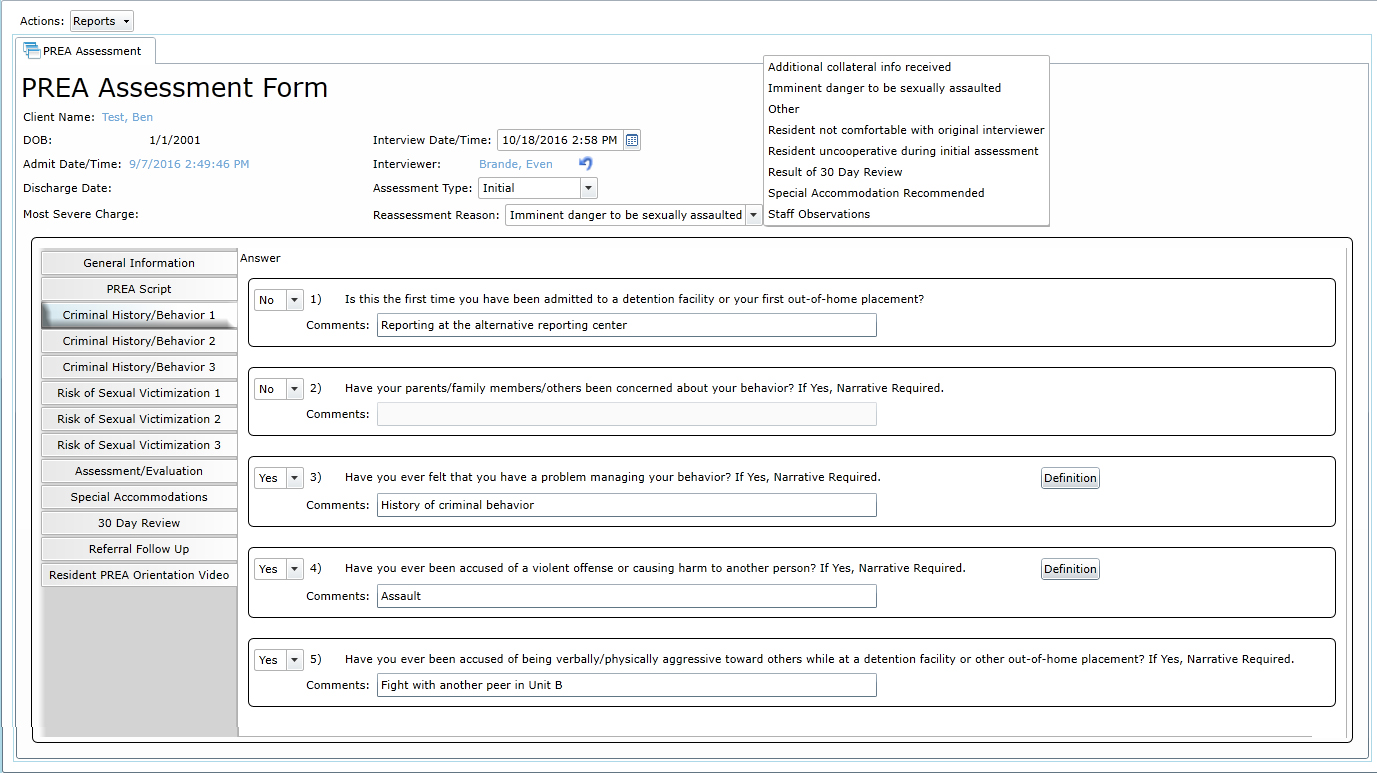
PREA standards require the use of risk assessments, PREA-related questions (e.g., sexual orientation, gender identification, etc.), agency documentation, and reporting to reach the outlined goals in the initiative.

During this recording, we will demonstrate those features in RiteTrack plus the following:
Handel has implemented RiteTrack software in numerous juvenile facilities, juvenile detention and juvenile treatment facilities. Register and watch this recording to see how RiteTrack assists facilities in the day-to-day operations as well as incorporating required PREA standards.

Juvenile facilities across the country have opted to work with Performance-based Standards to assist with monitoring confinement conditions in treatment services and residential facilities using national standards and performance outcomes.
PbS is a data-driven improvement model grounded in research that holds juvenile justice agencies, facilities and residential care providers to the highest standards for operations, programs and services.

Twice a year juvenile facilities compile data from day-to-day case management (including incident reports) and enter it into the PbS program interface. The PbS system then analyzes the data to assess whether the facility is meeting performance outcomes and uses this data to create summary reports. These analyses are used to create improvement plans and direct needed reforms in a facility.
Often during the months of April and October, many facilities who partner with PbS for this valuable service struggle with the time it takes for staff to perform daily responsibilities and reenter collected data into the PbS system.

However, in 2017 Handel met PbS at the Michigan Juvenile Detention Association (MJDA) Conference. Both of us saw the potential of a partnership between our two organizations. Over the next few months, we created a RiteTrack module that enables the PbS analysis system to integrate directly with RiteTrack’s case management and reporting solution which eliminates the duplicate data entry staff had to complete for the required reporting periods.

This RiteTrack and PbS integration enables juvenile detention and juvenile justice organizations’ staff to enter daily documentation into one case management system, RiteTrack—which also produces user friendly and reporting for other facility needs—while the integration module imports the required information directly into PbS’s system for the bi-annual reporting periods.
RiteTrack’s juvenile justice module captures required information like incident reports for PbS reporting. Because of the aligned data capture in the systems, information documented in RiteTrack is submitted to PbS through the one-of-a-kind integration module and eliminates duplicate data entry—saving detention staff and administration valuable time.
Contact us if you would like more information on the PbS and RiteTrack integration module or RiteTrack’s solution for juvenile justice and detention facilities.
If you missed the live webcast, click here for a recording that looks at the specific intake and risk assessment functionality available in the RiteTrack juvenile justice system.
Every size of facility from 10 beds to 100 or more beds must follow the same first step when a youth arrives: completing an intake process.
Many facilities also require some type of risk assessment as part of this process.

During this recording–showcasing a system which was designed with the needs of juvenile facilities at its heart–you will see the functionality that assists juvenile organizations with intake processes no matter the size or caseload.
If intakes and risk assessments have incorrect information or are incomplete, it complicates the admission process creating extra work for staff and administrators alike.
The extensibility of the system enables organizations to complete risk assessments within the software’s interface and can generate an easily digestible summary of the assessment data.
We covered the following items:
An information and case management system such as this ensures data is accurately entered, easily accessible, and simply reported on.
 If you were unable to attend the recent webinar on how RiteTrack is used for data generation in juvenile justice programs and system-of-care programs, you can now view that recording here.
During this webcast, Steve discussed the challenges facilities and system-of-care programs face when trying to generate reliable data to inform stakeholders of trends, issues, and successes.
He examined software that provides the day-to-day operations of a facility and showed real-world examples of how to utilize juvenile-specific data to improve decision about the youth in care and the operations of the facility.
Reports illustrated include:
You can also see best practices to use the data to inform decision-making by:
When reviewing DMC aspects, in my mind I kept coming back to the issue of how much needs to be encompassed when implementing and maintaining DMC standards into a juvenile justice program. These standards incorporate assessments, evaluation, and monitoring of juveniles in care. However, DMC doesn’t only apply to youth in detention. It really incorporates all areas of youth contact within the juvenile justice continuum of care.

Example of statistical report with DMC data.
Often DMC communities may have an alternative reporting center within it. I’m curious to see how information is communicated between one part in the juvenile justice continuum of care with another part. There is the potential for an enormous amount of time to be spent creating policies that address information sharing parameters, managing confidential information, and memorandums of understanding between these organizations. Even though data points like race, ethnicity, gender, geography, and offenses seem straightforward, these would likely need to be clearly defined with consensus from members of the continuum of care.
So how can organizations or programs in the juvenile justice continuum of care address information challenges like these? Using a web-based software like RiteTrack as the single-point-of-entry tool provides the framework from which programs can support the youth and the stakeholders.

Risk Assessment tool in the solution.
For a community to address DMC, there has to be involvement from shareholders in the community. There has to be planning and agreement on issues. Organizations must develop intervention that involves programming. Agencies need to evaluate whether the agreed upon plan is working. Finally, programs must be monitored to make sure that identified problems area continued to be addressed. Within all of these steps, the most important area may be the collection of data because youth data is pervasive in all these steps. RiteTrack collects data that occurs throughout all point of the juvenile justice continuum from first point-of-contact, risk assessment, community involvement, and if needed detention. In addition to extensive documentation, RiteTrack quickly generates reports and statistical data based on real-time data that is accurate and reliable. Implementing RiteTrack into operations is not just a procurement or download of another piece of software. It is a partnership with Handel IT to enhance and improve communities, not only by supporting a continuum of care, but also by creating a central point-of-entry to provide the framework to address DMC issues.
To see my most recent webcast reviewing DMC functionality and reporting in RiteTrack, click here and register to watch the recording.


RiteTrack facilitates easy navigation through hyperlinks.
The Red Lake Nation Oshkiimaajitahdah (New Beginnings) program recently began working with Handel Information Technologies to implement the RiteTrack TANF Module. Employment and Training staff will begin using RiteTrack in the coming months, followed by TANF as Red Lake Nation begins taking over TANF cases from Beltrami County.
Ramsey County, Minn. has partnered with Handel Information Technologies to implement a RiteTrack juvenile justice software solution to manage its juvenile detention and residential facilities.
The facilities using the powerful, new solution will be the Juvenile Detention Center and the Boys Totem Town.
“RiteTrack is capable of tracking the required data in a juvenile detention environment but also includes all of the functionality that the County’s residential facility needs for case and treatment planning,” said Dan Merth, Project Manager at Ramsey County Corrections Department.
Handel’s project manager said system planning and development is expected to last six-nine months with a flexible implementation timeframe of early 2015. “RiteTrack is designed well for projects where multiple facilities or departments are looking to merge their information sharing needs into one system. Through our proven track record with system design, data migration, and business and systems analysis even complex projects such as Ramsey County’s are launched and implemented quickly.”
RiteTrack will replace multiple systems; a legacy system which was created in an old programming language for the JDC which is no longer supported and a custom-built solution for the treatment facility.
The Mental Health and Juvenile Justice Collaborative for Change Web site says, “Providers rightfully tend to focus on meeting the needs of youth and families, but may fail to recognize the value of data collection and analysis. …In an environment in which demonstrating outcomes is critical, this oversight might be counterproductive.”
“The new RiteTrack system will generate real-time reports and notifications for case workers, administrators and stakeholders. The data collection and reporting capabilities will give the County high-quality information to produce client outcome information,” said Handel’s President Even Brande.
Ramsey County’s juvenile services provide “a structured and positive environment for the development of responsible youth with assistance from community partnerships and services within [the] County.”
RiteTrack, a Web-based juvenile justice software solution, tracks everything in juvenile diversion, detention, corrections and treatment cases from client demographics to treatment plans. This solution is designed to be the single point-of-entry into juvenile-serving agencies. As a youth enters a system, client information is entered into only one place.
Handel creates RiteTrack, a software solution used by juvenile service programs in state and county governments.
This July the Soboba Band of Luiseño Indians Tribal TANF has partnered with Handel Information Technologies who will deliver a TANF solution that will expand into an integrated software solution.
An important factor in the Tribe’s decision to upgrade to RiteTrack was the modular nature and consideration for future growth inherent in the solution.
As a Sovereign nation, our mission is to assist American Indian families and future generations to reach their fullest potential in securing economic stability while encouraging wellness in the family. Soboba Tribal TANF strives to provide welfare related services to eligible Native American families who meet all STTP requirements in an equitable and fair method according to customs and traditions.
Handel specializes in creating the best possible software solutions for American Indian service agencies. RiteTrack is software for tribal, state and county government. We work with tribal nations throughout the country in nearly every tribal department. With the experience and accountability that Handel offers, we are the trusted information solution that American Indian tribes can rely on.