Before AI, Focus on AI Data Quality
By Tiffany Edmonds
Artificial intelligence has quickly become one of the biggest conversations in technology. Across industries, organizations are exploring how AI can summarize information, identify patterns, support reporting, streamline documentation, and help staff make better use of the data they already collect.
For organizations that manage complex cases, services, funding requirements, compliance obligations, and community programs, that promise is exciting. AI has the potential to reduce manual work, surface useful insights, and help staff spend less time searching for information and more time using it.
But there is an important truth that often gets overlooked: AI is only as useful as the data behind it.
No matter how advanced a tool may be, it cannot produce reliable insights from incomplete, inconsistent, outdated, or poorly organized information. If the data going into a system is unclear, the results coming out of that system will be unclear too.
For Tribal governments, courts, probation departments, child welfare programs, TANF programs, child care programs, victim services, and other case management environments, this matters. These organizations are not just managing simple data points. They are managing people, services, histories, eligibility, outcomes, documentation, and decisions that can carry real weight.
That means the conversation about AI cannot start with AI alone. It has to start with AI data quality — the accuracy, consistency, and structure of the information behind the tool.
AI Does Not Fix Bad Data
One of the biggest misconceptions about AI is that it can automatically make sense of everything, regardless of how information is stored or entered. When in reality, AI depends heavily on the quality and structure of the information it is given. If records are incomplete, duplicated, outdated, or scattered across different systems, AI may struggle to provide anything meaningful. Worse, it may produce results that appear polished but are based on weak information.
For example, if a program wants to use AI to summarize case activity, that summary is only useful if the underlying case notes are accurate, timely, and entered in a consistent way. If important contacts, services, court events, placements, assessments, eligibility details, or follow-up actions are missing, the summary will be missing that context too.
The same is true for reporting. AI may be able to help identify trends or generate draft language, but it cannot replace the need for accurate program data. If data entry is inconsistent across staff or departments, the resulting analysis may not reflect what is actually happening.
AI can help organizations use their data more efficiently. It cannot magically create trustworthy data where it does not exist.
This is why organizations should be cautious about treating AI as a shortcut around deeper operational challenges. If a program is struggling with duplicate records, inconsistent documentation, unclear workflows, or reporting gaps, AI may simply make those issues more visible. The better long-term approach is to strengthen the data foundation first, then consider where AI can responsibly support the work.
Case Management Data Is Different
In many industries, data is relatively straightforward. A transaction happened, a form was submitted, a product was purchased, or a service was completed.
Case management data is more complicated.
A single person or family may interact with multiple programs over time. A case may include court hearings, service referrals, assessments, eligibility determinations, payments, documentation, appointments, communications, compliance requirements, and historical records. Staff may need to understand not just what happened, but when it happened, who was involved, why it matters, and what needs to happen next. That context is difficult to capture if an organization relies on disconnected spreadsheets, paper files, shared drives, email chains, or systems that were not designed around their actual workflows.
It also becomes more difficult when different programs, departments, or staff members use different terms for the same information. One staff member may document a contact one way, while another may record it somewhere else entirely. A service may be tracked in one system, while the outcome is stored in another. Over time, those small inconsistencies can make it harder to see the full picture.
This is where strong data practices become essential. Before AI can support better decision-making, organizations need a solid foundation for collecting, organizing, protecting, and retrieving information.
Better Data Starts With Better Daily Workflows
If staff are expected to enter information into a system that does not reflect how they actually work, data quality will suffer. If required fields are unclear, if processes vary widely from person to person, or if staff have to enter the same information in multiple places, inconsistency is almost guaranteed.
Strong data comes from systems and processes that make accurate documentation easier, not harder.
That includes things like:
- Clear expectations for what information should be entered
- Consistent terminology across staff and departments
- Structured fields for information that needs to be reported later
- Flexible note-taking areas for context that does not fit neatly into a checkbox (which, not everything does nor should we expect it to!)
- Defined workflows for approvals, reviews, deadlines, and follow-up
- Reports that help staff catch missing or incomplete information before it becomes a larger issue
When daily workflows are organized, the data becomes more organized too. And when the data is organized, AI has a much stronger foundation to work from.
This is especially important for organizations with limited staff capacity. In many programs, staff are balancing direct service, documentation, reporting, compliance, communication, and administrative work all at once. If data entry feels disconnected from the real work, it can become just another task on an already long list. But when the system supports the workflow, documentation becomes part of the process rather than something staff have to recreate later.
That distinction matters. AI tools are strongest when the information they rely on has been captured naturally and consistently.
Why AI Needs Context, Not Just Content
For organizations serving communities, context matters.
A case note by itself may not tell the full story. A missed appointment, a change in eligibility, a service referral, a court event, or a placement update may mean different things depending on the person, program, history, and surrounding circumstances.
AI tools are strongest when they can work with clear, relevant, well-structured information. This is especially important in Tribal and government program environments, where data may be tied to sovereignty, funding requirements, legal processes, family histories, community relationships, and culturally specific services. The goal should never be to remove human judgment from the process. The goal should be to give staff better access to the information they need so they can make informed decisions.
AI can assist. It can summarize, organize, and help identify patterns. But people still need to evaluate the information, understand the context, and make decisions grounded in experience, policy, and community needs.
In other words, AI may help bring information forward, but it should not be treated as the final authority. Staff still need to ask whether the information is complete, whether the summary is accurate, and whether the output reflects the full situation. Good data makes that review easier. Poor data makes it harder to know what can be trusted.
Data Governance Matters More Than Ever
As AI becomes more common, data governance becomes even more important.
Organizations need to know where their data lives, who has access to it, how it is protected, how it is used, and what rules guide that use. This is especially critical for organizations handling sensitive case information, personally identifiable information, court records, health-related details, family service records, or Tribal member data.
Before adopting AI tools, organizations should ask questions such as:
- What data would the AI tool access?
- Who controls/owns that data?
- Is sensitive information protected?
- Can access be limited by role or permission?
- Is there an audit trail?
- How are summaries or outputs reviewed?
- Are staff trained on appropriate use?
- Does the tool support the organization’s policies, or does it create new risks?
For many organizations, the most important first step is not choosing an AI tool. It is understanding their current data environment. That includes understanding what information is essential, what information is sensitive, what information needs to be reported, and what information should only be available to certain users. Strong data governance helps ensure that AI is used in ways that support the organization’s work without weakening privacy, security, or trust.
Preparing for AI Before AI Implementation
Organizations can begin preparing for AI implementation and usage by strengthening the way they manage information now.
That may include reviewing current workflows, cleaning up duplicate records, standardizing data entry practices, improving reporting processes, identifying gaps in documentation, and making sure staff have systems that support the work they are already doing.
It may also mean taking a closer look at whether current systems are helping or hurting data quality. If staff have to rely on workarounds, side spreadsheets, handwritten notes, or disconnected tools, that is usually a sign that important information is not being captured in a reliable way.
Preparing for AI can also be an opportunity to ask broader questions about how data is used across the organization. Are reports easy to generate? Are staff confident in the information they enter? Can leadership see trends without having to manually piece together data from multiple sources? Are program requirements built into the workflow, or do staff have to remember every step on their own?
The Real Value of AI Is Better Use of What You Already Know
AI should not be viewed as a replacement for staff expertise. In case management environments, staff knowledge is essential. Program staff understand the people they serve, the requirements they must meet, the realities of their communities, and the nuances behind the data. The real opportunity is helping staff make better use of the information they already have.
When data is accurate, organized, and accessible, AI can help reduce time spent digging through records, drafting repetitive summaries, identifying reporting trends, or pulling together information from multiple areas. That can give staff more time to focus on higher-value work: serving people, improving processes, meeting requirements, and making informed decisions.
But that value depends on the foundation underneath it.
AI can only reflect the quality of the data it receives. Clean, consistent, well-managed data creates stronger results. Messy, incomplete, or disconnected data creates more uncertainty.
For organizations that have spent years building program knowledge, maintaining records, and serving their communities, that data is valuable. It tells a story about services provided, needs identified, decisions made, outcomes tracked, and progress over time. AI may eventually help organizations understand that story more quickly, but only if the information behind it is reliable.
Moving Forward Thoughtfully
AI will continue to shape the future of case management, reporting, and program administration. For organizations that manage complex services and sensitive information, the opportunity is real.
But the strongest AI strategy starts with a strong data strategy.
Before asking what AI can do, organizations should ask:
Is our data accurate?
Is it complete?
Is it organized?
Is it protected?
Can staff find and use the information they need?
Do our systems support the way our programs actually work?
Those questions may not sound as exciting as artificial intelligence, but they are what make artificial intelligence useful.
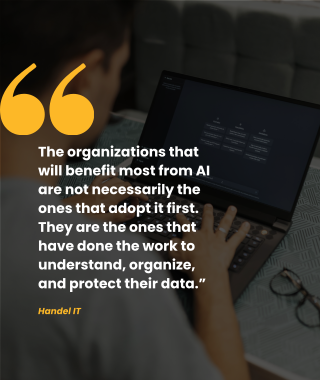
AI can be a powerful tool, but it is not a substitute for clear processes, thoughtful system design, responsible data governance, or staff expertise. The organizations that recognize this will be better positioned to adopt AI in a way that is useful, responsible, and grounded in the realities of their work.
Because at the end of the day, AI is not the foundation. Data is.